
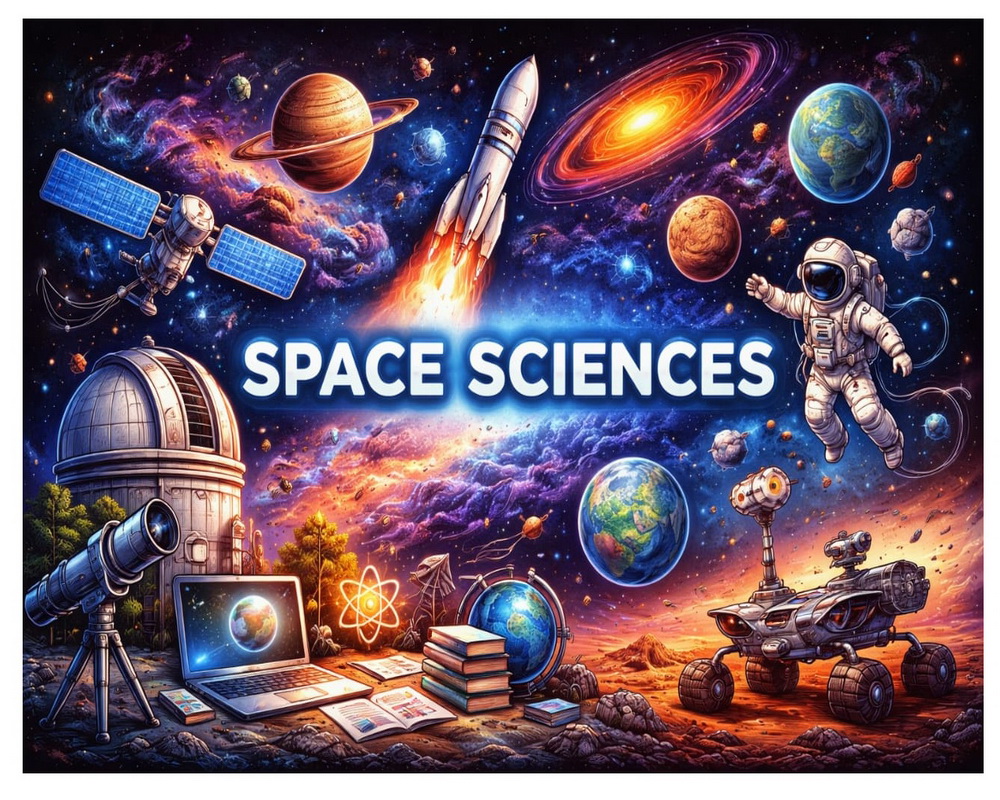
Space sciences encompass the systematic study of the universe beyond Earth’s atmosphere, integrating physics, astronomy, astrophysics, planetary science, and cosmology. This multidisciplinary field aims to unravel the mysteries of celestial bodies, cosmic phenomena, and the fundamental laws governing the cosmos.
Space Weather and Its Impact on Earth
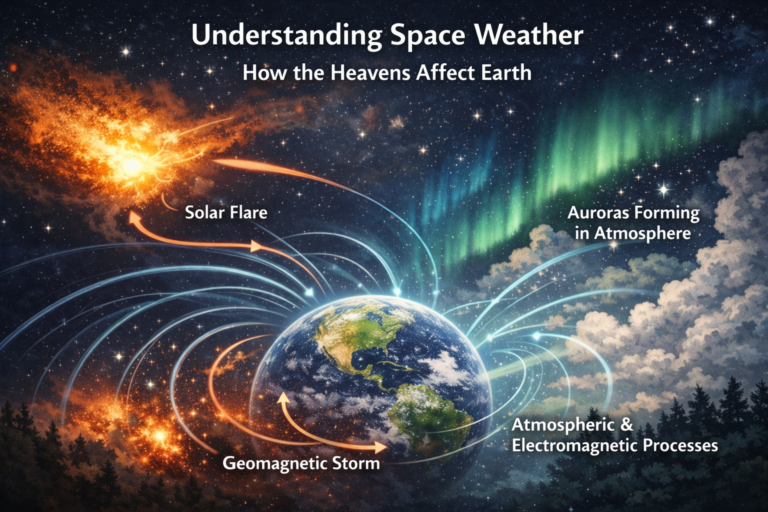
Space weather refers to the dynamic conditions in space influenced primarily by the Sun and its interactions with Earth’s magnetic field. Solar flares, coronal mass ejections (CMEs), and high-energy solar particles can disrupt satellite communications, GPS systems, and power grids on Earth. Earth’s magnetosphere acts as a protective shield, but extreme space weather events can produce spectacular auroras while posing risks to technology-dependent societies.
Stars: Cosmic Engines of Energy
Stars are massive luminous spheres of plasma held together by gravity and powered by nuclear fusion. They are the engines of chemical evolution in the universe, producing elements essential for life. Stars vary in size, age, and temperature, from small, cool red dwarfs to massive, hot blue giants. Studying their life cycles—from formation in nebulae to supernovae and black hole remnants—reveals the processes shaping galaxies.
Galaxies: The Cosmic Cities
Galaxies are vast assemblies of stars, gas, dust, and dark matter bound by gravity. They range from dwarf galaxies with a few billion stars to giants hosting trillions. Our galaxy, the Milky Way, is a barred spiral galaxy containing hundreds of billions of stars, including our Sun. Galaxies interact through collisions and mergers, influencing star formation and the large-scale structure of the universe.
Solar Systems: Planetary Neighborhoods
A solar system consists of a star and the celestial objects gravitationally bound to it, including planets, moons, asteroids, and comets. Studying solar systems helps us understand planetary formation, orbital dynamics, and the potential for extraterrestrial life. Our Solar System, with its diverse planets—from rocky Earth-like worlds to gas giants like Jupiter—serves as a laboratory for comparative planetology.
Black Holes and Wormholes: Extreme Frontiers
Black holes are regions in space where gravity is so intense that not even light can escape. They form from the collapse of massive stars and are key to understanding high-energy astrophysics and general relativity. Wormholes, theoretical tunnels through spacetime, remain speculative but tantalize physicists with possibilities of faster-than-light travel or connections between distant regions of the universe. These exotic phenomena challenge our understanding of physics and the fabric of reality.
The Cosmic Web: Large-Scale Structure
Beyond individual galaxies, matter in the universe forms a cosmic web of filaments, voids, and clusters shaped by gravity and dark matter. This large-scale structure reveals the evolution of the universe from the Big Bang to the present. Observations of cosmic microwave background radiation and galactic distributions provide critical clues about the universe’s origin, composition, and fate.
Conclusion
Space sciences offer a window into the fundamental workings of the universe. From space weather affecting our daily lives to the birth and death of stars, the complex interactions within galaxies, and the theoretical possibilities of black holes and wormholes, this field bridges observation, theory, and technology. As our tools for exploration advance, our understanding of the cosmos continues to deepen, reshaping our perspective of Earth and our place in the universe.
About the Author

This is amazing science.