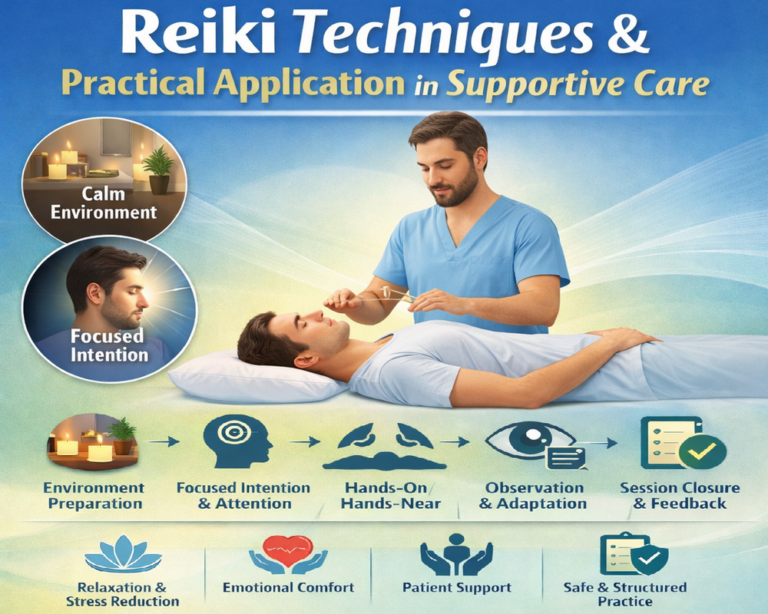
Reiki is commonly described as a gentle, non-invasive practice in which a practitioner offers focused attention, calm presence, and light hands-on or hands-near contact. It is widely used to promote relaxation, emotional balance, and overall well-being—particularly in contexts where stress, anxiety, or physical discomfort are present.
As understanding deepens through research and analysis, earlier assumptions about Reiki require refinement. In this revised framework, Reiki is no longer viewed solely as a psychological comfort technique, nor is it framed as a spiritual or mystical practice. Instead, Reiki is presented as a metaphysical, intention-driven method that operates within the natural laws governing energy, attention, and biological regulation.
This approach allows Reiki to be discussed responsibly—without exaggerated claims—while acknowledging its potential role as a supportive and, in some cases, healing means.
Origins and Historical Development of Reiki
Throughout human history, societies have developed methods to relieve pain, restore balance, and support recovery from illness. These methods have included herbal remedies, physical manipulation, counseling, prayer, and various forms of supportive touch. Such practices emerged from observation, experience, and engagement with the natural laws governing the human body.
Reiki belongs to this broader historical category of human-developed supportive methods.
Emergence of Reiki in Early 20th-Century Japan
Reiki, as a named practice, emerged in early twentieth-century Japan and is commonly associated with Mikao Usui (1865–1926). Historical accounts describe Usui as a lay scholar who explored contemplative and wellness practices common within his cultural environment, including meditation, self-discipline, and reflective exercises aimed at personal development and well-being.
It is important to clarify that Reiki did not originate as a religion, nor was it presented as divine revelation. Rather, it developed as a structured method of self-cultivation and supportive care, shaped by the intellectual and cultural context of its time.
Separation Between History and Interpretation
As Reiki spread beyond Japan, it was frequently reinterpreted—particularly in Western contexts—through spiritual, symbolic, or mystical frameworks. Concepts such as “attunement,” symbolic empowerment, and universal force narratives were introduced by later schools and traditions.
This framework deliberately separates historical development from later interpretive layers. While acknowledging that some Reiki traditions adopted symbolic or spiritual language, this presentation does not rely on or endorse those interpretations.
Foundational Clarifications
To avoid misunderstanding, several principles must be clearly stated:
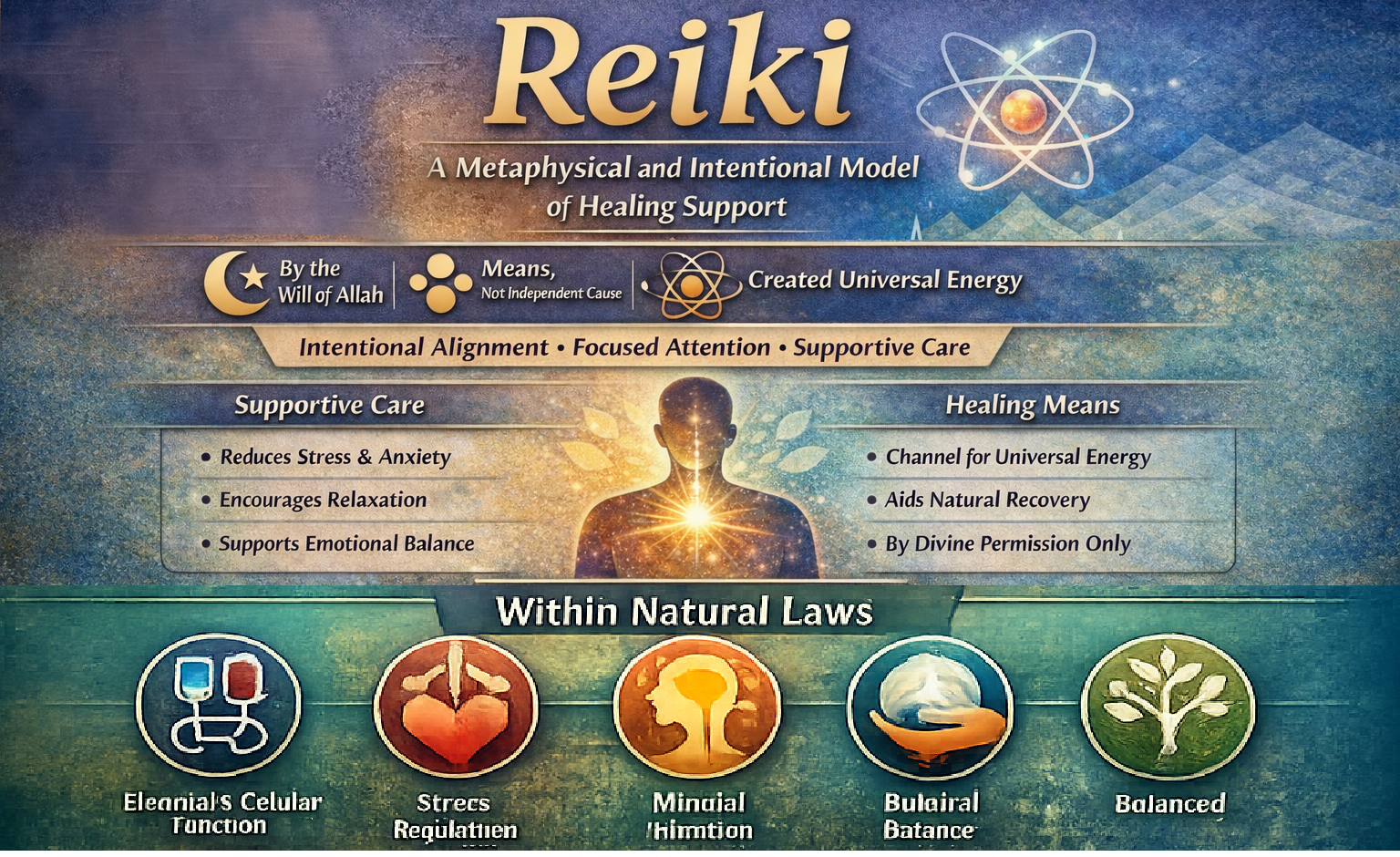
- Healing, benefit, and cure occur only by the will of Allah
- Human actions are means, never independent causes
- Energy, matter, and their interactions are creations of God
- Any benefit associated with Reiki occurs only by divine permission
Reiki is therefore not an autonomous force. It does not function independently of divine will. It is an attempted means, not a guaranteed outcome.
Reiki Beyond Spiritual Interpretation
Much confusion surrounding Reiki arises from its association with spiritual symbolism and ritualistic language. This framework intentionally removes such interpretations.
In this context:
- Reiki is not a religious practice
- It does not involve worship, invocation, or spiritual hierarchy
- It does not require belief systems, rituals, or symbols
- It does not claim supernatural authority
Instead, Reiki is approached as a structured metaphysical practice, grounded in intention, focused attention, and interaction with universal energy systems.
Universal Energy as a Created Phenomenon
Modern physics confirms that the universe is composed of energy and matter governed by consistent laws—from atomic interactions to electromagnetic fields. Energy underpins all physical existence.
Within this framework, universal energy is not an independent power or conscious force. It is:
- A created system
- Governed by divine laws
- Subject to divine will
- Accessible only within permitted boundaries
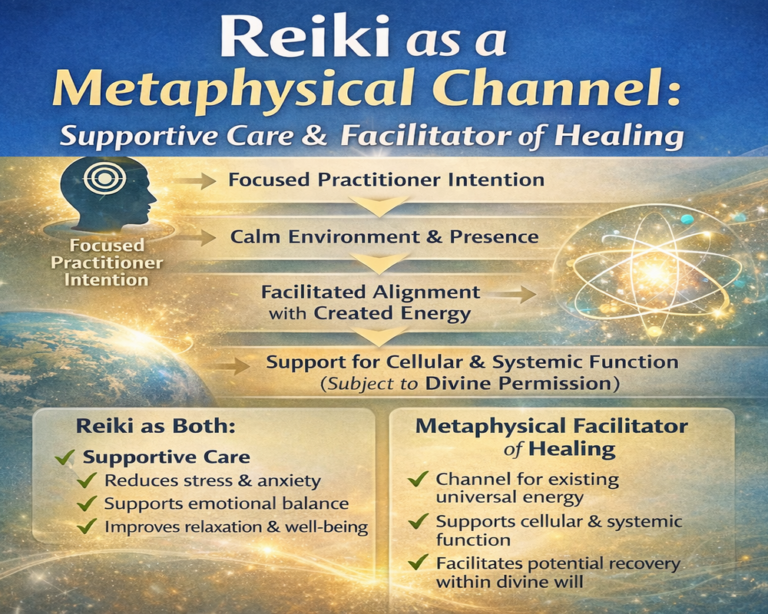
Reiki is therefore understood as an effort to align with and gather this created universal energy, not to command or generate it.
Reiki as a Channel, Not a Power
A critical distinction must be made between source and channel.
Reiki is not the source of healing. It does not create energy or control outcomes. Rather, it functions as:
- A channel for focused interaction with existing universal energy
- A method of intentional alignment, not energy production
- A means of facilitation, not outcome determination
The practitioner does not possess healing power. The practitioner applies structure, attention, and intention—while outcomes remain entirely beyond human control.
Intention as a Functional Component
Intention plays a central role in this model, but intention is defined functionally, not mystically. It refers to:
- Directed mental focus
- Conscious attentiveness
- Deliberate alignment of action
- Regulation of emotional and cognitive state
Scientific research increasingly recognizes that focused attention and intentional states influence stress response, nervous system regulation, and physiological balance. Reiki operates within this domain—not by overriding biology, but by interacting with it.
Reiki as Supportive Care and Healing Means
Within this revised understanding, Reiki occupies a dual position:
1. Supportive Care
- Reduces stress and mental tension
- Encourages relaxation and regulation
- Supports emotional balance
- Improves receptivity to recovery processes
2. Healing Means
- Acts as a channel for created universal energy
- Supports cellular and systemic function
- Operates within metaphysical laws
- Produces benefit only by divine permission
This dual role does not contradict medical science. Rather, it complements conventional care by addressing dimensions that medicine does not directly control.
Reiki and Biological Systems
Human biology operates through energy-dependent mechanisms, including:
- Electrical signalling across neurons
- Electrochemical gradients in cells
- Molecular energy exchange
- System-wide regulatory feedback loops
Disruption in these systems—through illness, injury, or stress—can impair function. Reiki does not repair these systems directly. Instead, it may support energetic balance and regulation, thereby assisting natural recovery processes. This is facilitation, not causation.
Reiki in a Modern Healthcare Context
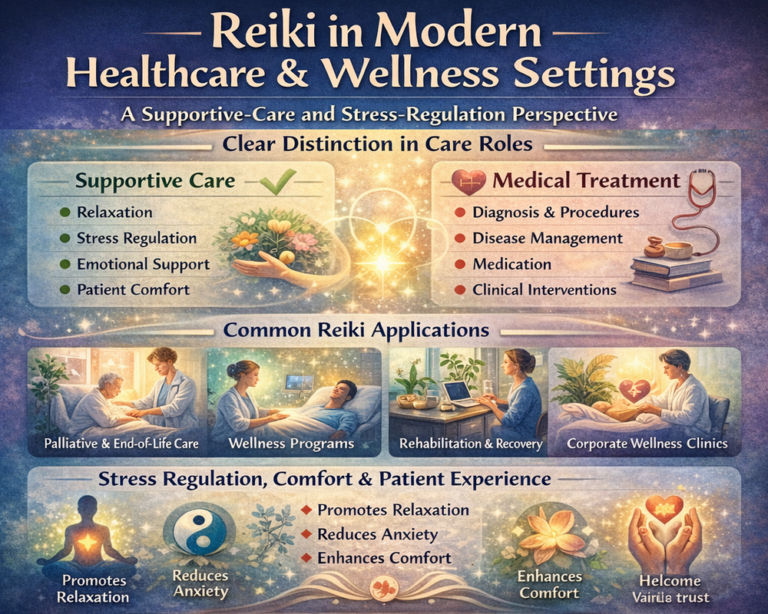
Today, Reiki is increasingly discussed in wellness and supportive-care environments such as:
- Stress management programs
- Palliative and comfort care settings
- Wellness and mindfulness initiatives
When used ethically and appropriately, Reiki may serve as a valuable adjunct to conventional care—particularly where relaxation and emotional support are beneficial.
What Reiki Is Not
For clarity, this framework explicitly rejects the following claims:
- Reiki as a guaranteed cure
- Reiki as spiritual initiation
- Reiki as religious worship
- Reiki as independent power
- Reiki as a substitute for medical treatment
Such claims undermine ethical practice and intellectual credibility.
A Clear Framework for Understanding Reiki
Reiki can be summarized within the following model:
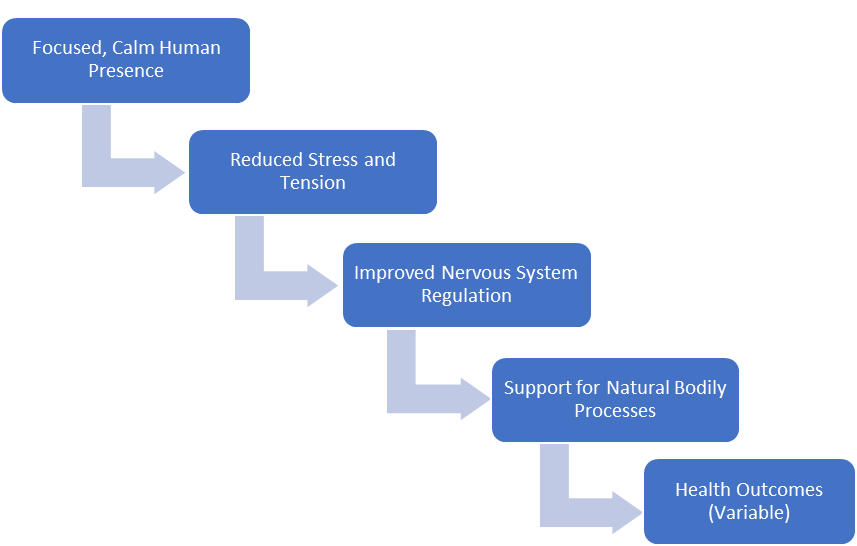
Human actions may support the process, but outcomes are never guaranteed.
Conclusion
Reiki, when stripped of exaggerated claims and spiritual mysticism, can be understood as a disciplined method of engaging with created universal energy through intention and focused attention. It is neither mere psychology nor supernatural intervention. It is an attempted means, operating within laws created by God, producing benefit only when permitted by Him. Such an understanding restores balance—respecting metaphysical science, maintaining theological clarity, and preserving ethical responsibility.
About the Author