Origins of Homeopathy
Homeopathy is a system of medicine developed in the late eighteenth century by the German physician Dr. Samuel Hahnemann (1755–1843). At a time when conventional medical practices commonly involved bloodletting, purging, and the use of toxic substances, Hahnemann became deeply concerned about the harm inflicted on patients in the name of treatment. His search for a safer and more rational therapeutic approach led to the foundation of homeopathy.
The central principle he proposed—Similia Similibus Curentur (“Like cures like”)—suggests that a substance capable of producing specific symptoms in a healthy individual can, when prepared appropriately, stimulate healing in a person suffering from similar symptoms. This concept marked a fundamental departure from the suppressive and often aggressive methods of medicine prevalent during his era.
Systematic Development and the Organon
Hahnemann did not arrive at his conclusions through speculation alone. He developed homeopathy through systematic experimentation, known as provings, in which substances were administered to healthy volunteers and their physical, mental, and emotional effects meticulously recorded. These observations formed the basis of remedy selection in homeopathic practice.
Equally significant was his introduction of potentization, a method involving serial dilution combined with succussion (vigorous shaking). Hahnemann asserted that this process reduced toxicity while enhancing the therapeutic action of substances. His ideas were consolidated in his seminal work, Organon of the Healing Art, first published in 1810. This text remains the foundational reference for classical homeopathy and outlines its philosophy, methodology, and clinical approach.
Global Expansion and Contemporary Practice
During the nineteenth century, homeopathy spread rapidly across Europe, the United Kingdom, North America, and the Indian subcontinent. It gained institutional presence through hospitals, colleges, dispensaries, and professional societies. Over time, homeopathy became deeply embedded in the healthcare landscapes of several countries.
Today, homeopathy continues to be practiced worldwide, particularly in India, Germany, Pakistan, and parts of Europe, where it exists within complementary and alternative healthcare systems. In many regions, it is regulated and taught formally, coexisting alongside conventional medicine rather than positioning itself in opposition to it.
Core Therapeutic Philosophy
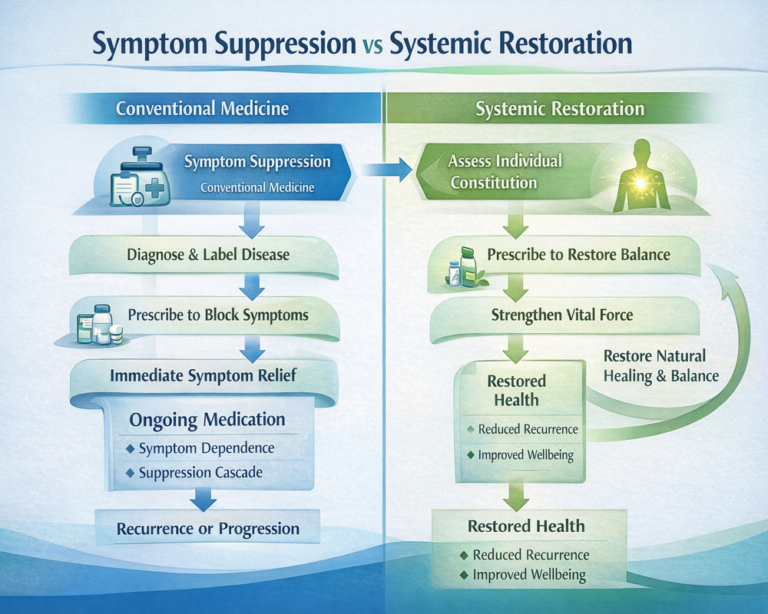
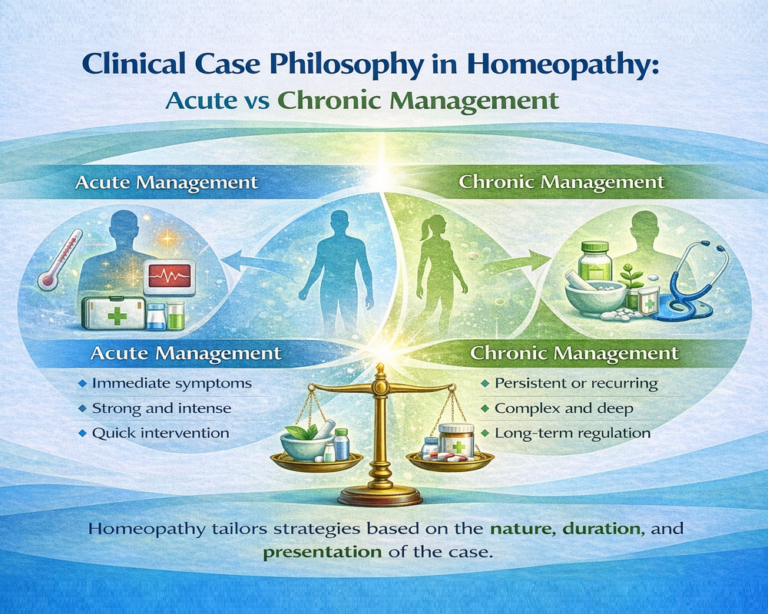
At its clinical core, homeopathy emphasizes individualized treatment. Rather than prescribing remedies based solely on disease labels, practitioners assess the totality of a patient’s physical symptoms, emotional state, mental disposition, and personal history. Treatment is intended to stimulate the body’s inherent self-regulatory and healing capacity rather than directly suppress symptoms.
Homeopathic remedies are prepared using highly diluted substances through potentization, a process believed to impart qualitative therapeutic properties distinct from material concentration alone. This approach places homeopathy outside conventional dose–response pharmacology and into a different therapeutic paradigm.
Scientific Debate and Mainstream Perspectives
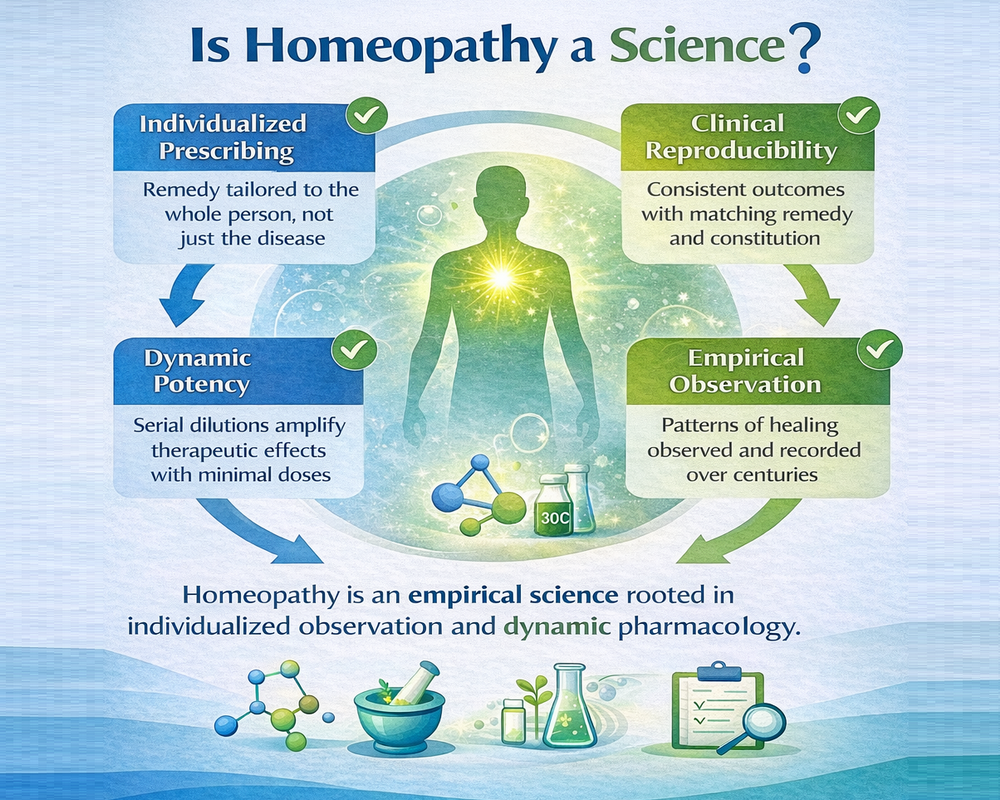
Homeopathy’s core principles—particularly the use of extreme dilutions beyond Avogadro’s number and the idea that the diluent may retain therapeutic information—remain points of contention within mainstream chemistry, physics, and biology. From a conventional scientific standpoint, such dilutions are statistically unlikely to contain measurable quantities of the original substance.
As a result, modern biomedical science generally recognizes homeopathy’s value primarily in terms of patient-centered care, perceived well-being, and holistic engagement, while questioning its material mechanisms of action. Nevertheless, the continued global use of homeopathy has sustained ongoing scientific inquiry into alternative explanatory models.
Understanding Avogadro’s Number
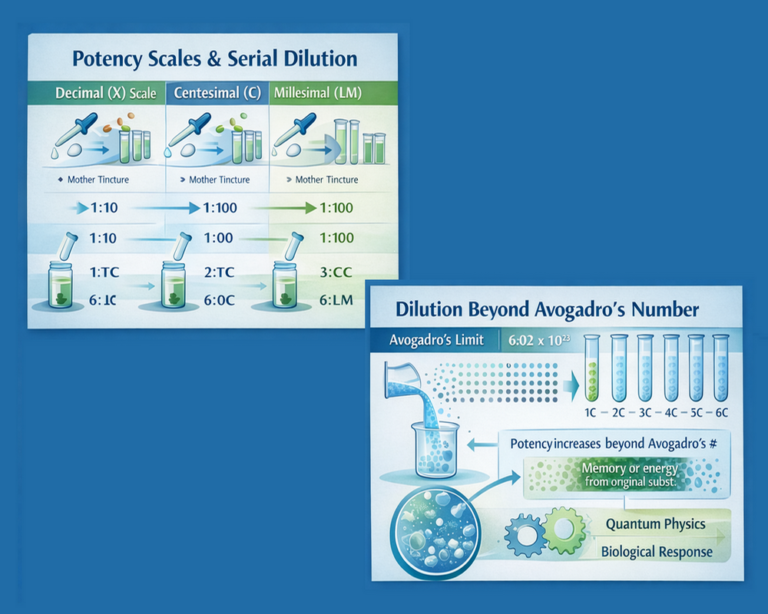
Avogadro’s number (6.022 × 10²³) represents the number of molecules present in one mole of any substance. In practical terms, repeated dilution of a substance reaches a point where the probability of even a single molecule of the original material remaining becomes negligible.
In homeopathy, remedies are commonly prepared using serial dilutions such as:
- C-scale (C or CH): 1 part substance diluted in 99 parts solvent at each step
- 12C: Approximately 1 part in 10²⁴, crossing Avogadro’s limit
- 30C: Approximately 1 part in 10⁶⁰, far beyond Avogadro’s number
From the perspective of conventional chemistry, dilutions beyond approximately 12C (or 24X) are statistically devoid of original molecules, hence the term “extreme dilutions beyond Avogadro’s number.”
Nanoparticles and Emerging Hypotheses
Recent exploratory research has introduced alternative hypotheses to explain homeopathic preparations. During the processes of trituration (grinding) and succussion, it has been proposed that nanoparticles or nanostructures of the original substance may persist in solution, even at very high dilutions.
Notably, studies by Chikramane et al. (2010–2013) reported detecting nanoparticles of metals such as gold, silver, and copper in certain homeopathic remedies using advanced analytical techniques, including:
- Transmission Electron Microscopy (TEM)
- Inductively Coupled Plasma–Atomic Emission Spectroscopy (ICP-AES)
These studies suggested that:
- Nanoparticles may originate from the source material during succussion
- Serial dilution reduces concentration but may not entirely eliminate nanoparticles
- Such nanoparticles could theoretically interact with biological systems in non-classical ways
While these findings remain exploratory and have not yet led to broad scientific consensus, they represent ongoing efforts to examine homeopathy through contemporary scientific tools.
Conclusion
Homeopathy emerged as a response to the medical excesses of its time and developed into a structured system grounded in observation, individualization, and long-term clinical engagement. Although its principles differ fundamentally from conventional biomedical models and remain scientifically debated, homeopathy continues to be practiced globally and investigated through evolving scientific perspectives.
Understanding homeopathy requires recognizing that different medical systems may operate on different scientific assumptions, methodologies, and definitions of evidence—a reality that continues to shape the modern dialogue between conventional and complementary medicine.
About the Author