Homeopathy and conventional medicine represent two distinct yet potentially complementary approaches to healthcare. While modern biomedicine is grounded in reductionist science, biochemical mechanisms, and standardized protocols, homeopathy functions as a system-based medical science with its own philosophy, pharmaceutics, and therapeutic logic. Understanding their differences requires examining not only outcomes, but also the foundational assumptions upon which each system is built.
Philosophical Foundations
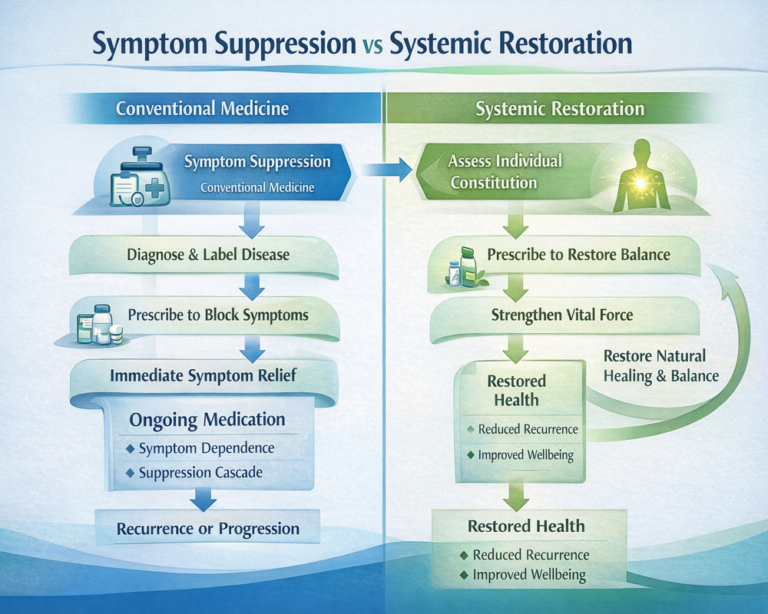
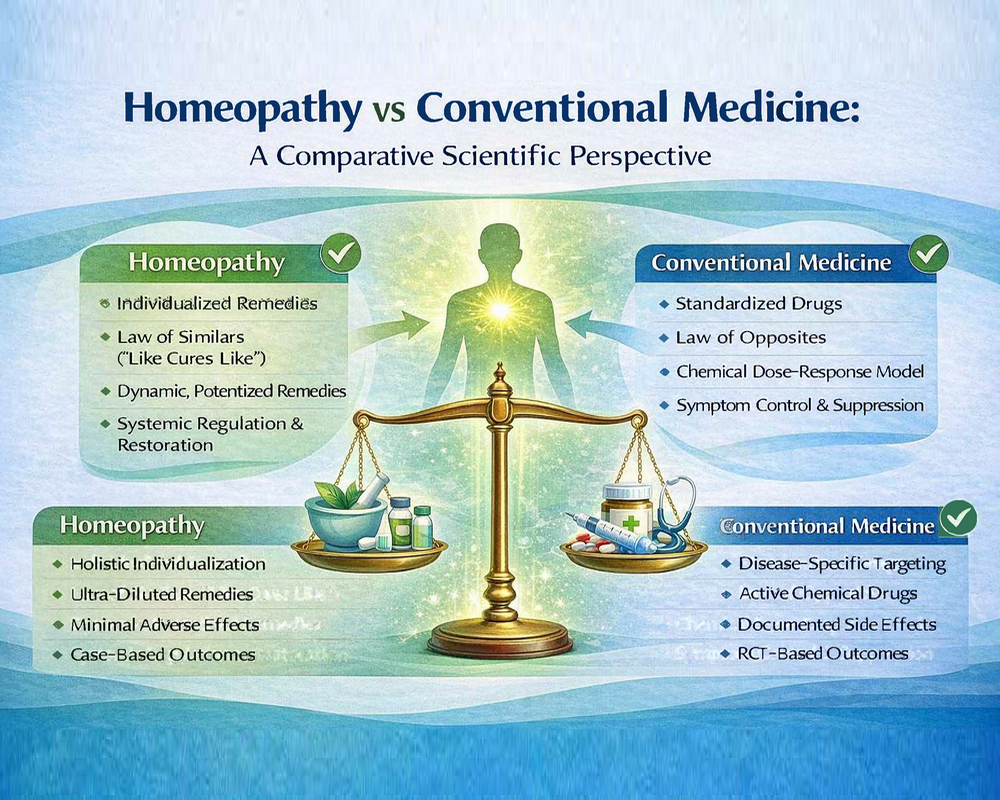
Conventional medicine is largely disease-centered. It focuses on identifying pathological processes—such as infection, inflammation, degeneration, or genetic dysfunction—and intervening through pharmaceuticals, surgery, or technological procedures designed to suppress, replace, or remove the affected tissue or function.
Homeopathy, by contrast, is patient-centered and systems-oriented. Its philosophy is based on the premise that disease reflects a dynamic imbalance within the living organism. Treatment therefore aims to stimulate regulatory and self-healing mechanisms rather than directly opposing symptoms. This philosophical distinction explains why homeopathy prioritizes individualized prescriptions and long-term constitutional correction.
Therapeutic Strategy and Scope
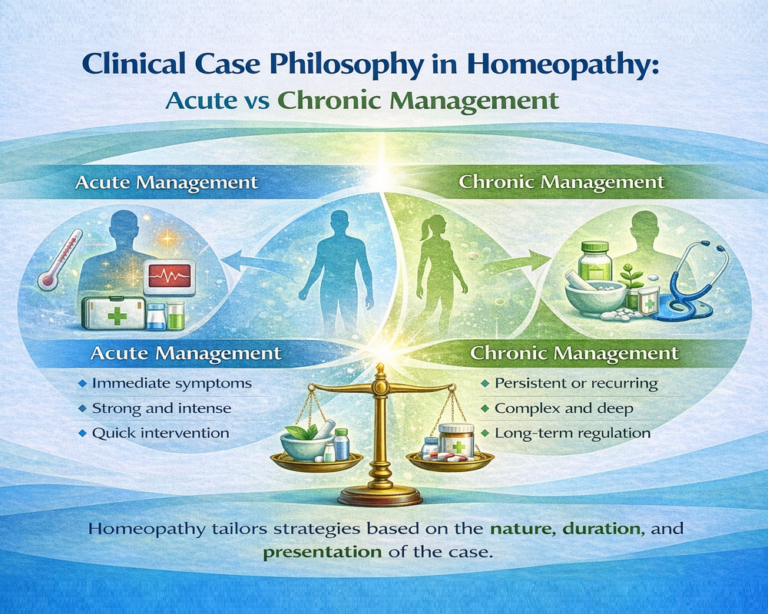
Conventional medicine excels in acute care, trauma management, infectious disease control, and surgical intervention. Its strengths lie in rapid symptom control and life-saving procedures. Homeopathy does not deny or compete with these strengths; rather, it acknowledges surgery and emergency medicine as essential where structural damage or immediate risk exists.
Homeopathy’s therapeutic strength lies in functional, chronic, and recurrent conditions, where deep-acting remedies are used to restore organ function, improve systemic balance, and reduce disease progression. In this framework, the objective is to heal or stabilize an organ before irreversible pathology necessitates removal or replacement.
Potency, Dilution, and Avogadro’s Limit — Explained Simply
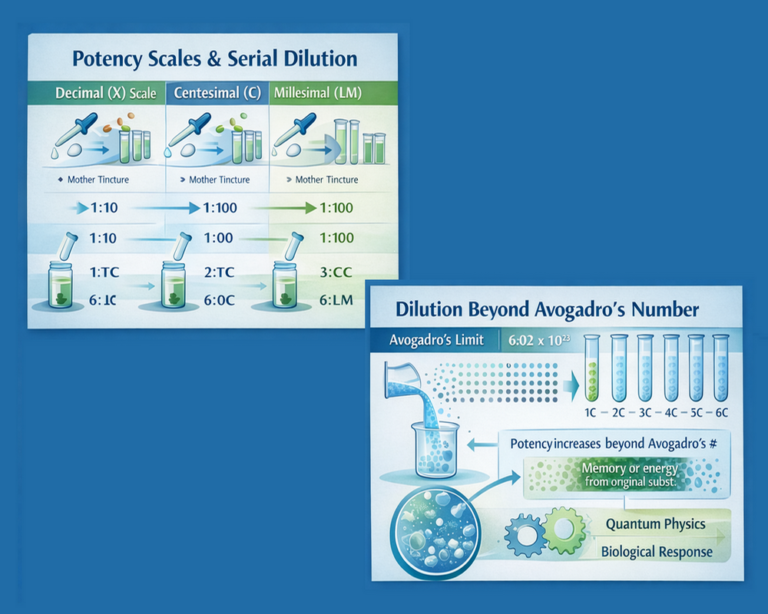
One of the most debated aspects of homeopathy is its use of potentized medicines prepared through serial dilution and succussion. From a conventional chemical perspective, dilutions beyond Avogadro’s number imply the absence of measurable molecules of the original substance. Modern science interprets this as pharmacological inactivity.
Homeopathy approaches potency differently. In this system, therapeutic effectiveness is not dependent on material quantity, but on the qualitative transformation of the medicinal substance through potentization. Higher dilutions are understood to act at regulatory, energetic, or informational levels rather than through direct molecular interaction. This concept aligns more closely with emerging scientific fields such as complexity science, biofield research, and non-linear biological systems, which recognize that biological responses are not always dose-dependent in a linear manner.
Scientific Competitiveness and Evidence Paradigms
Homeopathy should not be evaluated solely through methodologies designed for conventional drugs. Randomized controlled trials focusing on isolated symptoms may fail to capture the individualized, holistic, and time-dependent nature of homeopathic treatment. The lack of extensive funding and institutional research has further limited large-scale studies, but this does not invalidate the internal consistency, reproducibility within practice, or clinical observations accumulated over two centuries.
From this perspective, homeopathy can be regarded as a fully competitive scientific treatment system, operating under a different epistemological model—one that emphasizes systems regulation, patient individuality, and minimal intervention.
Integrative Outlook
Rather than positioning homeopathy and conventional medicine in opposition, a rational healthcare model recognizes their complementary roles. Conventional medicine addresses structural pathology and emergencies, while homeopathy focuses on early intervention, chronic disease modulation, and long-term health preservation. When applied responsibly, both systems can coexist in a manner that prioritizes patient outcomes over ideological alignment.
Frequently Asked Questions (FAQs)
Is homeopathy against conventional medicine or surgery?
No. Homeopathy fully recognizes the necessity of surgery and emergency care when required. Its aim is to prevent disease progression through timely intervention whenever possible.
Can homeopathy treat serious or long-term diseases?
Homeopathic practice considers many remedies to be deep-acting and suitable for chronic and long-standing conditions, focusing on systemic correction rather than symptomatic suppression.
Why is homeopathy still debated scientifically?
Because its principles do not align neatly with conventional biochemical models, and because large-scale research funding has been limited. This reflects methodological challenges rather than definitive scientific failure.
Conclusion
Homeopathy and conventional medicine arise from different scientific worldviews. While modern biomedicine dominates current healthcare systems, homeopathy remains a structured, philosophically rigorous, and clinically practiced medical science. Recognizing its unique framework allows for informed dialogue, integrative application, and a broader understanding of what constitutes science in medicine.
About the Author