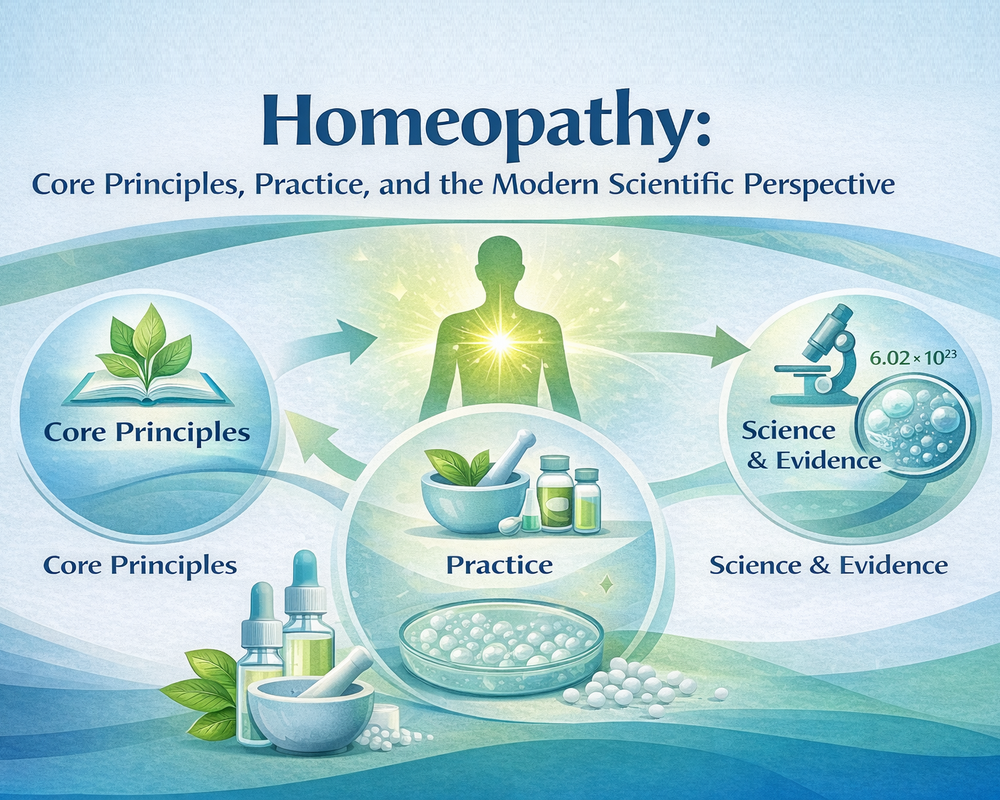
Homeopathy is a holistic system of complementary medicine that approaches health and disease through the lens of the individual rather than the illness alone. Building upon the foundational ideas introduced by Dr. Samuel Hahnemann, homeopathy emphasizes gentle intervention, personalization of treatment, and support for the body’s inherent capacity to maintain balance.
Fundamental Principles of Homeopathy
At the heart of homeopathy lies the principle of “Similia Similibus Curentur” (Like Cures Like). This concept proposes that substances capable of producing specific symptoms in a healthy individual may help relieve similar symptoms in an unwell person when administered in highly diluted forms. Treatment selection is therefore guided by symptom similarity rather than disease labels.
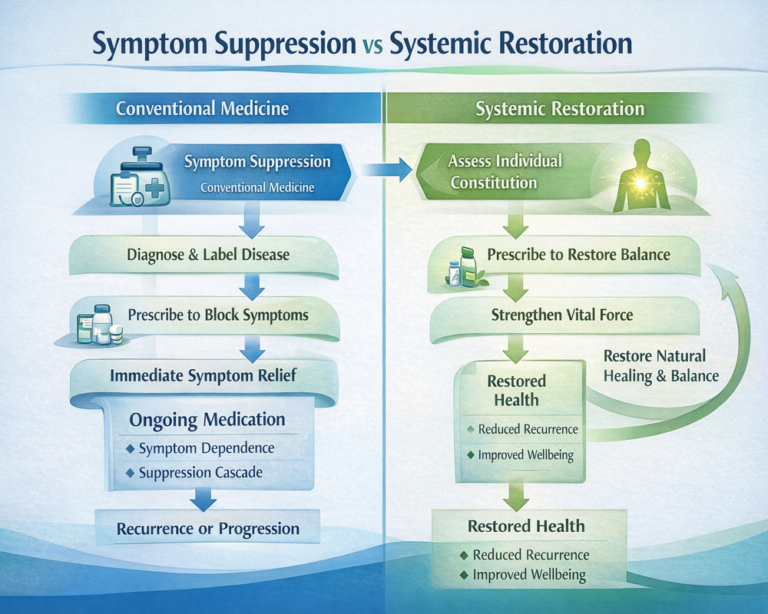
Another defining principle is individualization. Two people with the same medical diagnosis may receive entirely different remedies, as homeopathy considers physical symptoms alongside mental, emotional, and constitutional characteristics. This patient-centered approach distinguishes homeopathy from standardized treatment protocols used in conventional medicine.
Preparation of Homeopathic Remedies
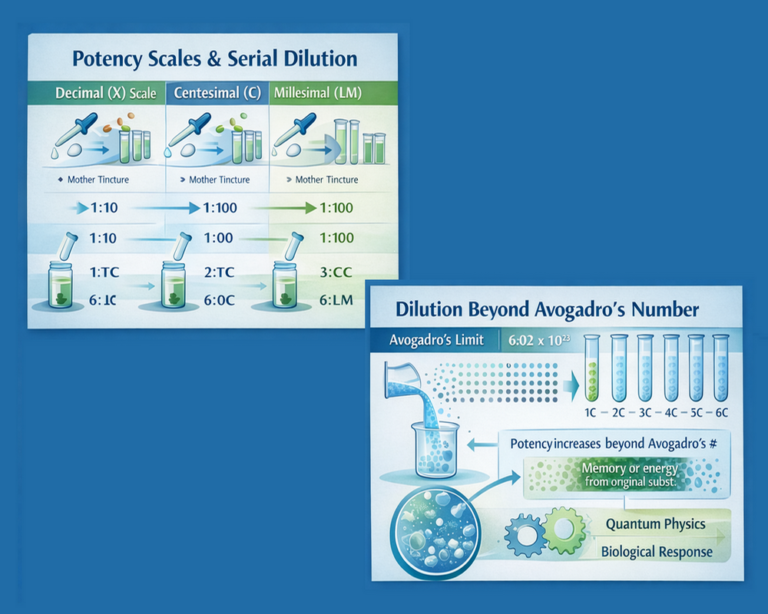
Homeopathic medicines are prepared through a method known as potentization, involving serial dilution and succussion (vigorous shaking). According to homeopathic philosophy, this process reduces toxicity while enhancing the therapeutic potential of the remedy. Remedies are commonly prepared in decimal (X), centesimal (C), or millesimal (LM) scales, with higher potencies representing greater dilution.
From a scientific standpoint, many high-potency remedies are diluted beyond Avogadro’s number, meaning no measurable molecules of the original substance are expected to remain. This aspect remains the primary point of contention between homeopathy and conventional science.
Homeopathy and Scientific Debate
Modern science assesses therapeutic systems primarily through reproducibility, linear dose–response models, and currently accepted frameworks of biological plausibility. When examined solely through these parameters, homeopathy is often characterized as inconclusive or placebo-based. This interpretation, however, reflects the limitations of prevailing scientific models rather than a definitive refutation of homeopathy itself. Homeopathy operates on principles that extend beyond conventional biochemical interactions and therefore cannot be fully evaluated using tools designed for reductionist pharmacology alone.
Despite limited large-scale research and the non-responsiveness of contemporary scientific institutions, homeopathy represents a coherent, internally consistent, and clinically practiced system of medicine with over two centuries of empirical application. Emerging concepts—such as nanoscale phenomena, complex systems biology, and non-linear biological responses—suggest that the absence of immediate scientific validation does not equate to the absence of an underlying scientific reality. In this view, homeopathy may be regarded as a developing frontier science: rigorous in philosophy, methodical in practice, and awaiting scientific instruments and paradigms sufficiently evolved to fully elucidate its mechanisms.
Role of Homeopathy in Contemporary Healthcare
Today, homeopathy is categorized as a complementary and alternative medical system. In countries, specially in India, Germany, Pakistan and generally in USA, Canada, UK and other European countries, it is formally recognized and practiced alongside conventional medicine, often as part of integrative healthcare models. Its continued popularity is largely attributed to its non-invasive nature, holistic consultations, and emphasis on patient well-being.
Homeopathy represents a comprehensive system of alternative medicine that addresses disease through a holistic, individualized, and curative approach. While modern biomedical science often evaluates therapies through narrow parameters such as molecular dose–response relationships and short-term clinical trials, homeopathy operates within a broader therapeutic philosophy focused on restoring functional balance and supporting the body’s innate healing capacity. The absence of widespread scientific endorsement should therefore be viewed not as a dismissal of homeopathy, but as a reflection of the current limitations of conventional research models in evaluating complex, system-based therapies.
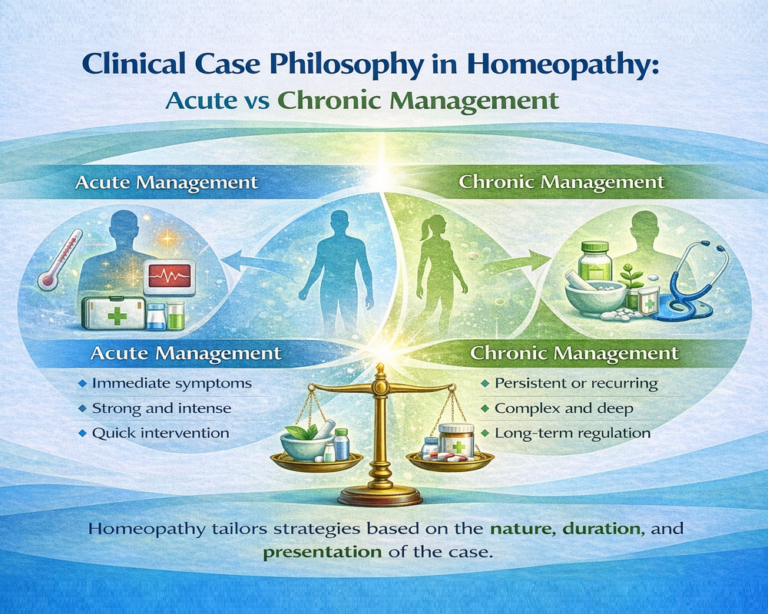
Clinically, homeopathy is widely regarded by its practitioners and patients as effective for a broad spectrum of conditions, ranging from acute illnesses to chronic and long-standing diseases. Its remedies are considered deep-acting, aiming not merely to suppress symptoms but to correct underlying disturbances at constitutional and organ levels. In serious or progressive conditions, homeopathy does not oppose modern medical interventions; rather, it recognizes the necessity of surgery and emergency care where indicated. Its fundamental objective, however, is timely therapeutic intervention—to support healing, preserve organ function, and potentially prevent irreversible damage that would otherwise necessitate surgical removal.
Conclusion
Homeopathy may be understood as a structured and evolving medical science with a long history of clinical application, emphasizing individualized care, deep-acting remedies, and organ-preserving treatment. Although modern science has yet to fully align with or explain its mechanisms, homeopathy continues to function as a complementary and alternative medical system addressing both acute and chronic diseases. By integrating respect for conventional medical and surgical needs with a preventive and restorative philosophy, homeopathy positions itself as a patient-centered discipline focused on healing rather than replacement—seeking to restore health before invasive intervention becomes unavoidable.
About the Author