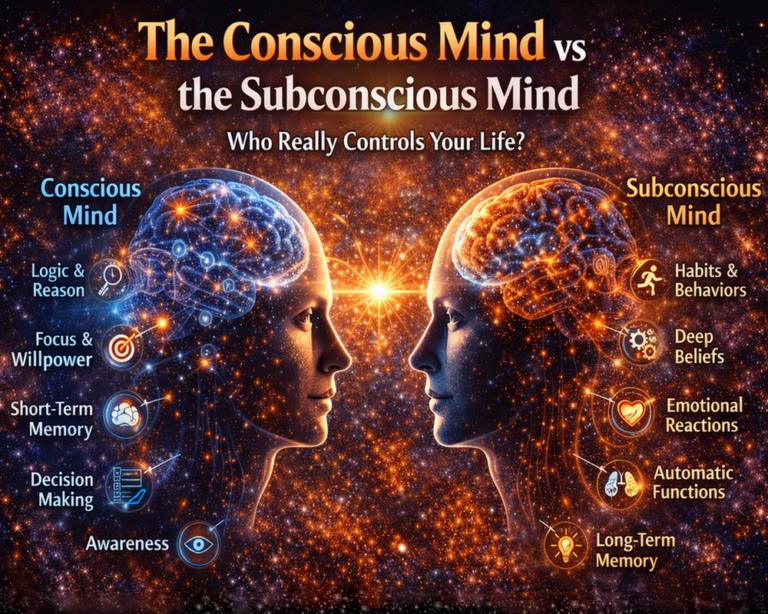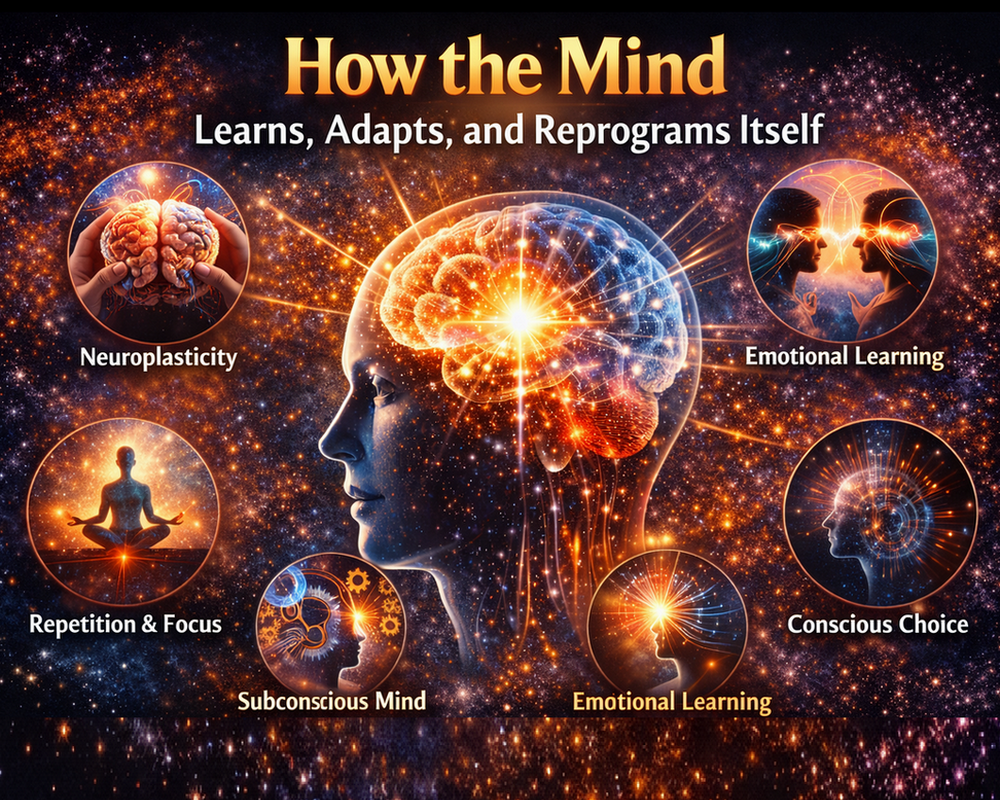
Lets explore how the mind actually learns, adapts, and changes over time. One of the most powerful discoveries across psychology, neuroscience, and applied mind training is that the human mind is not fixed—it is adaptable, trainable, and continuously shaped by experience.
Neuroplasticity: The Mind’s Ability to Change
Neuroplasticity refers to the brain’s capacity to reorganize itself by forming new neural connections. Thoughts, habits, emotions, and repeated behaviours physically shape the brain. This explains why practices such as meditation, hypnosis, NLP, and cognitive training can create lasting mental and behavioural change when applied consistently.
The Role of Repetition and Focus
The mind strengthens whatever it repeatedly focuses on. Repeated thoughts and actions become automatic mental patterns, often operating below conscious awareness. This principle explains both negative habits and positive transformation—what the mind rehearses, it eventually becomes.
The Subconscious Mind and Automatic Programming
A large portion of mental activity occurs at the subconscious level. Beliefs, emotional reactions, and habitual responses are often programmed early in life and reinforced over time. Techniques such as hypnosis, visualization, Silva Mind Control, and subconscious programming work by accessing this deeper layer of the mind and gently reshaping it.
Emotions as Learning Signals
Emotions play a central role in how the mind encodes experiences. Strong emotional states accelerate learning and memory formation. When emotional awareness is developed through mindfulness and meditation, individuals gain greater control over reactions and decision-making.
Conscious Choice and Mental Training
While much of the mind operates automatically, conscious awareness allows intervention. Practices such as mindfulness, meta-cognition, and cognitive behavioral techniques train individuals to observe thoughts rather than be controlled by them. This awareness is the foundation of intentional mental reprogramming.
Why This Matters in Everyday Life
Understanding how the mind learns and adapts explains:
- Why habits feel difficult to break
- How stress patterns become chronic
- Why focused intention produces measurable results
- How long-term mental training leads to personal transformation
Mind Sciences is not about instant change—it is about structured, repeatable mental conditioning that aligns thought, emotion, and behaviour.
Closing Thought
The mind is not a passive system—it is a learning organism. Every thought, emotion, and repeated action leaves an imprint. By understanding how the mind adapts and reprograms itself, individuals gain the ability to consciously shape their mental world rather than react to it.
About the Author